Family Planning Services
Integrating Family Planning with public sector primary health care services is an effective way to reduce unmet needs of family planning. Despite decades of progress in improving the delivery and availability of family planning services, high levels of unmet need for family planning still prevalent in Pakistan. Innovative approaches are needed to extend access to family planning services to women and couples who desire to limit or space their childbearing but are not currently using contraceptives. The integration of family planning with other health services is one such approach.
Prior to 2020, family planning services faced substantial hurdles, including low awareness, inconsistent demand and supply, and a lack of human resource capacity. The rapidly growing population of Islamabad exacerbated these issues, with family planning counseling and services failing to make a notable impact. Data fragmentation at the Primary Health Care (PHC) level further complicated service delivery, while reporting from Family Welfare Centers (FWCs) in the District Health Information System (DHIS) was largely incomplete. Additionally, the absence of a digitalized data entry system hindered effective monitoring and evaluation. Recognizing these challenges, the merger of family planning services with the District Health Office (DHO) under the Ministry of National Health Services, Regulation, and Coordination (NHSR&C) became a necessity. The decision was formalized through the Federal Government’s approval, as outlined in the Cabinet Division’s Memorandum No. 4 – 11/2019-Min-I, dated December 23, 2019. The notification, issued on January 3, 2020, detailed the following mergers:
I. The Directorate of Central Warehouse & Supplies (CW&S), Karachi, merged with the Population Program Wing of the Ministry of NHSR&C. This integration ensured that CW&S, Karachi, became an integral part of the Ministry, streamlining logistics and supply management for population programs.
II. The Islamabad Blood Transfusion Authority (IBTA) was merged with the Federal Health Regulatory Authority (FHRA), enhancing regulatory oversight and operational efficiency in blood transfusion services.
III. The National Health Information Resource Centre (NHIRC) was integrated with the Health Planning System Strengthening and Information Analysis Unit (HPSIU), consolidating data management and health planning resources to support evidence-based decision-making.
IV. The District Population Welfare Office, Islamabad, was merged with the District Health Office (DHO), ICT. This strategic move aimed to provide better family planning, reproductive health, and mother-and-child health services across the Islamabad Capital Territory.
Need Assessment
Integration of Family Planning
reduced from 44% in 2012-13 to 35% in 2017/18. Whereas, unmet need for FP in ICT Islamabad has increased over the last five years from 12.5% in 2012-13 to 17.3% in 2017-18.
With a staggering 207 million population, Pakistan is the fifth most populous country in the world. With an annual population growth rate of 2.4%, Pakistan’s population is growing at a faster rate than its South Asian neighbors’. If unchecked, high population growth and fertility rates adversely impact human development in a country. According to the PDHS 2017-2018 the modern contraceptive use in Islamabad Capital Territory (ICT) has drastically
To support the Federal Government’s efforts aimed at enhancing FP uptake, Jhpiego, under UNFPA funded program, has been developing an integrated model of FP services and counseling and Primary Health Care. Since September 2020, Jhpiego has extended support in the areas of capacity building, strengthening of facilities and community engagement by training of 130 LHWs in Islamabad. To appropriately design and launch the initiative, Jhpiego conducted a need assessment study in October 2020, which informed the intervention as well as served as baseline, at the five health facilities in Islamabad (ICT Model). The five facilities for need assessment were identified by DHO Office ICT Islamabad as these required improvements.
These facilities are:
- RHC Tarlai
- RHC Barakahu
- RHC Sihala
- BHU Jhang Syeedan
- BHU Sohan
Summary of Challenges
- Only a few facilities had a minimal number of IUCD Kits, while none had PPIUCD, Implant, or IP Kits.
- Facilities experienced frequent shortages of both long-term and short-term FP methods, with many not receiving FP commodities for over two years.
- Pregnancy care, delivery services, and postpartum FP services were identified as critical unmet needs.
- Facilities lacked equipment for sterilization and disinfection and did not have waste management or infection prevention guidelines.
- Health facilities were understaffed, with some staff either untrained or last trained on family planning (FP) methods over two years ago.
- Most facilities lacked proper infrastructure, such as dedicated counseling rooms with necessary privacy and equipment.
Integration of Family Planning
planning methods, implants, and referrals for sterilization services.
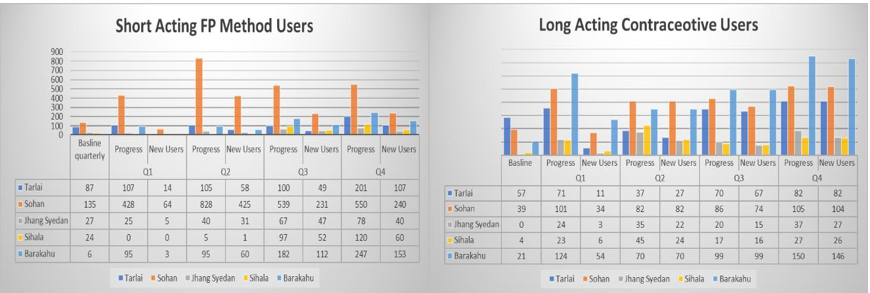
As of May 31, 2022, the project has thus far provided client counseling for family planning. A total of 7,235 clients were counseled at the 05 targeted health facilities. Moreover, the project ensured FP services to 7,917 clients and 4,905 new clients were persuaded for uptake of FP services.
The integrated model has provided an opportunity to offer wide range of FP and MNCH services under one roof, where health care providers offer a full range of PHC services, including family planning including short and long-acting family
A shortage of informational materials and national FP service guidelines was reported.
There was no robust internal system to ensure quality FP/PFP services.
While facilities referred clients to tertiary care hospitals, only some maintained referral logs or tracking systems for client follow-up.
Technical Approach
Based on the identified gaps in the need assessment such as need for infrastructure improvements such refurbishments of labor rooms, establishment of separate counseling areas and provision of equipment and supplies. It is pertinent to note that these facilities were providing only short acting FP services and through these intervention FP services were piloted for an approximate catchment population of approximately 500,000.
Integration of Family Planning
Progress of FP Services Utilization during 2021
5 targeted facilities at ICT have made prominent improvement in FP services utilization. Overall, more than 200-point percentage (n=433) improved in FP services utilization from the period of November 2020-November 2021 over the baseline (n=136). Similarly, Short acting contraceptive utilization improved 216-point percentage (n=326) over the baseline (n=103) and long acting contraceptive consumption enhanced 230-point percentage (n=109) over the baseline (n=33) during 2021.
Besides the challenges of stock out of short acting commodities the utilization in the first half of the year the utilization was better than the baseline. Apart from these, the targeted facilities also provided client counseling for family planning. Total 4,279 clients were counseled in the health facilities for family planning. The data showed an
interesting correlation between number of clients counselled and the number of clients that uptake FP services. The data reveals that higher numbers of counseling has resulted in higher numbers of FP services utilization. As observed in the case of BHU Sohan.